
How to Pass the TELC B1 German Exam in 2026: The Complete Strategy Guide
Everything you need to pass the TELC B1 German exam on your first attempt — exam format, section-by-section strategies, study plan, scoring breakdown, and the preparation mistakes that cost most people their certificate.

If you are reading this, you probably have a TELC B1 exam coming up — and you want to make sure you pass. Maybe you need the certificate for German citizenship, a Niederlassungserlaubnis, or a job requirement. Whatever the reason, this guide gives you the exact strategy to pass the TELC B1 German exam on your first attempt.
Here is the reality: passing TELC B1 does not require perfect German. It requires understanding how the exam works, knowing what the examiners actually grade, and preparing in a targeted way. Around 30–40% of test takers fail — but almost all of them fail because of poor preparation strategy, not because their German is too weak.
The 60% Rule
You need 60% in both the written and oral sections to pass TELC B1. That means you can get 40% of the answers wrong and still pass. The exam is designed to be achievable — but you must pass both parts independently. A 90% on writing cannot compensate for a failed speaking section.
TELC B1 Exam Format: What You Actually Face on Exam Day

The TELC B1 exam has two main parts: the written exam (about 2.5 hours) and the oral exam (about 15–20 minutes). The written exam includes Leseverstehen (reading comprehension), Sprachbausteine (grammar and vocabulary), Hörverstehen (listening comprehension), and Schreiben (writing). The oral exam is Sprechen (speaking), which you do with a partner — another test taker, not the examiner.
The total score is 300 points: 225 for the written part and 75 for the oral part. You need at least 135 points on the written exam and 45 points on the oral exam. These thresholds are non-negotiable — passing one section brilliantly cannot save a failed other section.
Leseverstehen (Reading): How to Score Maximum Points
The reading section gives you about 65 minutes and has three parts. Part 1 asks you to match headings to short texts — a global comprehension task. Part 2 is detailed reading with multiple-choice questions about a longer text. Part 3 asks you to match short texts (like advertisements or notices) to descriptions of people's needs.
The single most effective strategy for Leseverstehen is this: read the questions first, then scan the text for answers. Do not read the full text start to finish. This is not a language class — it is an exam. Your job is to find information as quickly as possible.
- •Part 1 (Heading Matching): Read all headings first. Then read each short text and eliminate headings as you go. There is always one extra heading that does not fit — this is intentional to test whether you are reading carefully.
- •Part 2 (Multiple Choice): Read the question and all answer options before looking at the text. Underline the key phrase in the question. Then scan the relevant paragraph for that specific information. Watch out for near-synonyms — TELC rarely uses the exact same word in both the text and the correct answer.
- •Part 3 (Matching): Read the people's situations carefully and note what each person specifically needs. Then scan the texts looking for matches. Be precise — a text might seem to fit but miss one critical detail.
Pro Tip: Sprachbausteine
The Sprachbausteine section (grammar fill-in-the-blank) comes right after reading. Many test takers lose points here on prepositions and verb-preposition combinations. Memorize the 30 most common fixed expressions: sich interessieren für, sich freuen auf/über, abhängen von, achten auf, etc. These appear in almost every TELC B1 exam.
Hörverstehen (Listening): The Section Where Most People Lose Unnecessary Points
The listening section has three parts and takes about 25–30 minutes. Here is the critical thing most guides do not tell you: Part 1 (Globalverstehen) plays only once. Parts 2 and 3 play twice. If you do not know this going in, you will lose easy points on Part 1 simply because you were not focused enough during a single play.
- •Before each audio track, you get time to read the questions. Use every second of this time. Underline the key information you need to listen for: times, prices, places, reasons, names.
- •Do not try to understand every word. Listen for the specific information that answers each question. If you miss something, move on immediately. Dwelling on a missed answer costs you the next one.
- •Practice listening without headphones. In the real exam, audio is played over speakers in a room — not through earphones. The sound quality and room acoustics are different from listening on your phone.
- •Common TELC listening trap: the audio mentions two options or changes an answer mid-sentence. For example, someone says a meeting is at 14:00, then corrects themselves and says 14:30. The correct answer is always the final, corrected information.
Schreiben (Writing): The Template Strategy That Gets You Safe Points
The Schreiben section gives you about 30 minutes to write a semi-formal or informal letter or email. You will receive a prompt describing a situation and 3–4 content points you must address. The most important thing to understand: you are graded on task completion, structure, and communication — not on having perfect grammar.
A clearly structured letter with a few grammar mistakes will score higher than a rambling letter with perfect grammar that misses one of the content points. Every content point you skip is a direct point deduction.
- •Use a clear 4-part structure every time: greeting → reason for writing → address each content point in separate paragraphs → polite closing. This structure works for any TELC B1 writing prompt.
- •Memorize these opening phrases: "Sehr geehrte Damen und Herren," (formal) or "Liebe/Lieber [Name]," (informal). Start with: "Ich schreibe Ihnen, weil…" or "Vielen Dank für Ihre Nachricht."
- •Memorize these closing phrases: "Ich freue mich auf Ihre Antwort." / "Vielen Dank im Voraus." / "Mit freundlichen Grüßen" (formal) or "Liebe Grüße" (informal).
- •Check every content point in the prompt before submitting. Put a small tick mark next to each one you have addressed. Missing a content point is the single most common reason for failing the writing section.
Writing Scoring Insight
TELC B1 writing is scored on three criteria: (1) task completion — did you address all content points? (2) communicative design — is your text structured and coherent? (3) correctness — grammar, spelling, vocabulary. Criteria 1 and 2 are worth more than criterion 3. Structure and completeness beat perfect grammar.
Sprechen (Speaking): 25% of Your Score in 15 Minutes
The speaking section is worth 75 out of 300 total points — a full 25% of your score. You do it with a partner (another test taker), and two examiners observe and assess you both. There are three parts.
- •Part 1 — Kontaktaufnahme (Introduction): You and your partner introduce yourselves and have a brief small-talk conversation. This is the easiest part. Prepare a 1-minute self-introduction covering your name, where you are from, what you do, and why you are learning German. Then ask your partner a question.
- •Part 2 — Gespräch über ein Thema (Topic Discussion): You receive a topic card and give a short presentation (about 2 minutes). Then your partner asks you questions and you discuss. Common topics: health, travel, learning, technology, family, environment. For each topic, prepare 3 key points: your opinion, one advantage, one disadvantage.
- •Part 3 — Gemeinsam eine Aufgabe lösen (Joint Planning): You and your partner plan something together — a party, a trip, a gift. You need to make suggestions, respond to your partner's ideas, and reach a joint decision. Use phrases like: "Ich schlage vor, dass…", "Was hältst du davon?", "Das ist eine gute Idee, aber…", "Einverstanden!"
The most important rule for the speaking exam: keep talking. Pauses, silence, and switching to English kill your score. If you forget a word, describe what you mean using simpler words. Examiners reward communication strategies — showing you can work around gaps is literally part of the B1 assessment criteria.
The 6-Week TELC B1 Study Plan
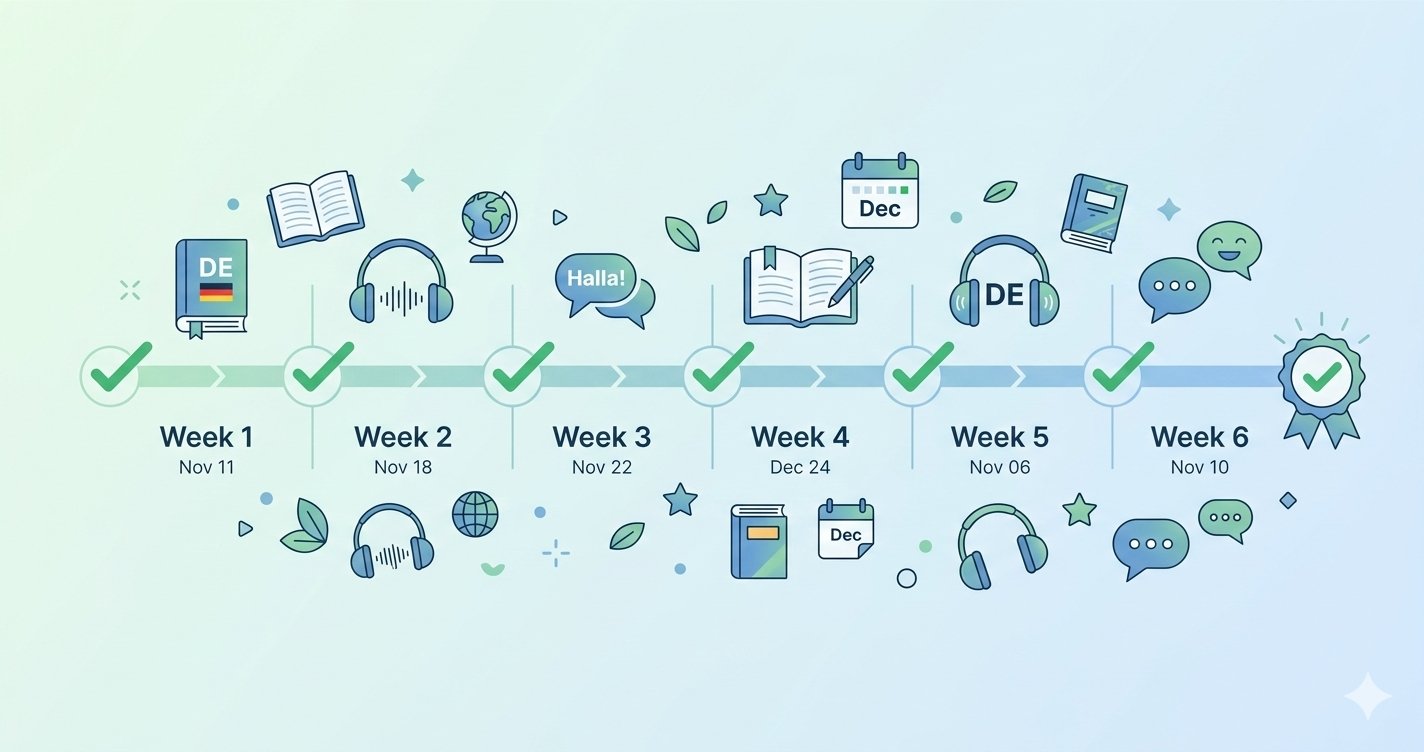
This study plan assumes you already have a basic B1 level (you can hold simple conversations and understand everyday texts). If you are still at A2, give yourself 10–12 weeks instead.
- •Week 1–2: Format Familiarization — Take one full mock test under timed conditions. Do not study first — just take the test to see where you are. Identify your weakest section. Then spend these two weeks understanding the exam format and doing untimed practice for each section.
- •Week 3–4: Targeted Drilling — Focus 60% of your time on your weakest section. Drill Sprachbausteine (prepositions, verb combinations). Write 3 practice letters and get feedback. Start daily listening practice with B1 podcasts (Slow German, Easy German). Record yourself answering speaking prompts.
- •Week 5: Full Mock Tests — Take 2 complete timed mock tests this week, simulating real exam conditions. Review every wrong answer. For writing, compare your letters against TELC model answers.
- •Week 6: Final Polish — Light review only. Focus on your memorized templates for writing and speaking. Take one final mock test 3 days before the exam. Rest the last 2 days — arriving stressed and exhausted costs more points than an extra study session.
The 7 Most Common Mistakes That Cause People to Fail
- •Not practicing under timed conditions. The TELC B1 exam is a speed test as much as a language test. If you have never done a full mock test with a timer, you are not prepared.
- •Ignoring speaking practice. Many self-studiers focus 90% on reading and grammar and 10% on speaking. But speaking is 25% of your total score and must be passed independently.
- •Studying grammar rules without doing practice tests. Knowing grammar rules is not the same as applying them under time pressure. Practice tests build the automatic recall you need.
- •Not reading the writing prompt carefully. Skipping one content point is an automatic major point deduction — even if the rest of your letter is excellent.
- •Trying to understand every word in the listening section. You do not need to understand everything. You need to find specific answers to specific questions.
- •Not preparing set phrases for speaking. Examiners listen for B1-appropriate expressions. "Ich schlage vor", "meiner Meinung nach", "ich stimme zu" — these signal B1 competence.
- •Cramming the night before. The TELC B1 exam tests language skills built over weeks and months. One all-night session adds anxiety, not ability.
What Happens If You Fail One Part?
Good news: if you pass the written exam but fail the oral exam (or vice versa), you do not have to retake the entire test. TELC allows you to retake only the failed section within one year. Check with your specific test center for their retake policy and fees — this usually costs between €100 and €150 for a partial retake.
Your TELC B1 certificate, once issued, is valid indefinitely. Unlike IELTS or TOEFL which expire after two years, a TELC certificate never expires. This is one of the major advantages of the TELC system.
Where to Register and What to Bring
You can take the TELC B1 exam at any authorized TELC test center — Volkshochschulen (VHS), private language schools, and dedicated exam centers across Germany. Registration typically closes 2–4 weeks before the exam date, depending on the center. You need a valid passport or official ID (Personalausweis) with a photo. No dictionaries, phones, or smartwatches allowed in the exam room.
Results arrive 4–6 weeks after the exam. Some centers offer expedited correction for an additional fee. When you pass, you receive an official TELC B1 certificate that is recognized by employers, universities, and government authorities throughout Germany and the EU.
How LevelKraft Helps You Prepare Faster
The biggest problem with traditional TELC B1 preparation is the feedback gap. You write a practice letter — but who checks it? You record a speaking practice — but who tells you if your grammar is costing you points? Textbooks give you model answers, but they cannot tell you what is wrong with your specific performance.
LevelKraft closes this gap. The app provides full TELC-format mock tests for all four sections — Lesen, Hören, Schreiben, and Sprechen — with AI-powered feedback delivered in under 2 minutes. For the writing section, you get specific feedback on task completion, structure, grammar, and vocabulary range. For speaking, you record your answer and receive analysis of pronunciation, fluency, and content quality.
Practice Like the Real Exam
LevelKraft's B1 mock tests follow the exact TELC format: same number of questions, same time limits, same scoring criteria. When you sit down on exam day, nothing should feel unfamiliar. Download LevelKraft free on Google Play and take your first full practice test today.
Quick Check: Are You Ready for TELC B1?
5 questions to test whether your exam strategy is solid. Score + explanations after each answer.
1. What minimum score do you need in EACH section to pass TELC B1?
2. In the Hörverstehen, how many times does Part 1 (Globalverstehen) play?
3. What is the most common reason people lose points in the Schreiben section?
4. During the speaking exam, what should you do if you forget a German word?
5. Is the TELC B1 certificate valid indefinitely?
Verwandte Themen
Mit LevelKraft für deine B1-Prüfung üben
Vollständige Modelltests, KI-Feedback und Fortschrittsverfolgung — kostenlos.
App kostenlos ladenAlles zur TELC B1 Prüfung
Prüfungsaufbau, Tipps, FAQ und Schnelltest