
TELC B2 Sprechen: 3-Part Strategy + Redemittel Sheet
Part-by-part telc B2 Sprechen strategy: Über Erfahrungen sprechen, Diskussion, Gemeinsam etwas planen — with Redemittel and the four scoring criteria.

The telc B2 Sprechen exam is where the step from B1 to B2 becomes very visible. At B2 the criteria ask for varied language and for reacting to your partner's arguments — partial agreement and qualified disagreement are good ways to show this. The speaking part is worth 75 of the 300 points (25%) and must be passed on its own with at least 45 points.
The format has three parts: Über Erfahrungen sprechen (talking about an experience), Diskussion (a discussion with your partner), and Gemeinsam etwas planen (a joint planning task). You receive 20 minutes of preparation time before the exam. The oral exam takes about 15 minutes for two candidates (about 25 for a group of three).
B2 vs B1 Sprechen: The Differences
At B1 you exchange opinions on an everyday topic and plan something simple together. At B2, you are expected to: (1) report on an experience in a connected way and answer questions about it; (2) discuss a controversial topic based on a text, with arguments and reactions to your partner; (3) bring your own ideas into a planning task and react to your partner's suggestions; (4) use varied language. The language bar is clearly higher.
Teil 1: Über Erfahrungen sprechen (Talking About an Experience)
Duration: about 5 minutes for both candidates. You choose one of seven topics — a book you read, a film you saw, a trip, a music event, a sports event, a person who was important in your life, or an important experience — and talk about it for up to one and a half minutes. Then your partner asks you questions. After that you swap roles. You can prepare this part at home, but speak freely — recited texts are not wanted. It is a short talk, not a formal presentation with a thesis, statistics or charts.
A simple structure for your experience report:
- •1. Say which topic you chose. "Ich möchte über eine Reise sprechen, die ich letztes Jahr gemacht habe."
- •2. Give the key facts (what, when, where, with whom). "Im Sommer war ich mit zwei Freunden eine Woche in…"
- •3. Describe what happened or what it is about. "Zuerst… Danach… Besonders interessant war, dass…"
- •4. Say what you thought of it and why. "Mir hat besonders gefallen, dass… / Was mich überrascht hat, war…"
- •5. Round off in one sentence. "Insgesamt war das eine Erfahrung, die ich nicht vergessen werde."
- •As the listener: ask at least one genuine question. "Was hat dir am besten gefallen?" / "Würdest du das noch einmal machen?"
The seven topics are printed in the official practice test (Übungstest 1 on telc.net) — prepare two or three of them properly.
Teil 2: Diskussion (Discussion with Your Partner)
Duration: about 5 minutes. In the preparation time you both read a short text on a controversial topic. First say briefly which points of the text you find interesting (up to one minute), then discuss: give your opinion and arguments, react to your partner's arguments and make suggestions. This is not two monologues — it is a real discussion.
For your own contributions, a simple argument pattern helps: position ("Ich vertrete die Meinung, dass…"), argument with example ("Dafür spricht, dass… Zum Beispiel…"), reaction to the other side ("Man könnte einwenden, dass… Dem halte ich entgegen, dass…"), short conclusion ("Deshalb bin ich der Überzeugung, dass…").
A good way to show range in this part is nuance — not only "Ich stimme zu" or "Ich stimme nicht zu", but also partial agreement and qualified disagreement:
- •Full agreement: "Da stimme ich Ihnen vollkommen zu." / "Das sehe ich genauso." / "Ich teile Ihre Meinung."
- •Partial agreement: "In gewisser Hinsicht haben Sie recht, allerdings…" / "Das stimmt teilweise, aber man muss auch bedenken, dass…" / "Grundsätzlich stimme ich zu, möchte aber einschränken, dass…"
- •Polite disagreement: "Da bin ich anderer Meinung." / "Das sehe ich etwas anders." / "Ich kann Ihren Standpunkt nachvollziehen, bin aber nicht überzeugt, weil…"
- •Countering an argument: "Dem möchte ich widersprechen, denn…" / "Das Argument überzeugt mich nicht, weil…" / "Man darf aber nicht vergessen, dass…"
- •Asking for clarification: "Könnten Sie das etwas genauer erläutern?" / "Was genau meinen Sie damit?" / "Haben Sie dafür ein konkretes Beispiel?"
The Discussion Mindset
Do not try to "win" the discussion. What counts is that you take part in a balanced exchange — listen, respond, and engage with your partner's ideas. Participation in the conversation is assessed under Aufgabenbewältigung. A mix of agreement, partial agreement, and polite disagreement gives you the chance to show varied language.
Teil 3: Gemeinsam etwas planen (Joint Planning Task)
Duration: about 5 minutes. You and your partner plan an event — for example a celebration, a concert, a conference, an exhibition or a sports event. You bring in ideas, discuss options, and agree on a joint plan.
Useful Redemittel for this part:
- •Making suggestions: "Ich würde vorschlagen, dass wir…" / "Wie wäre es, wenn wir…" / "Eine Möglichkeit wäre, …" / "Wir könnten in Betracht ziehen, …"
- •Responding to suggestions: "Das klingt nach einem guten Plan." / "Das ist ein interessanter Vorschlag, aber haben Sie bedacht, dass…" / "Ja, das wäre eine Möglichkeit. Alternativ könnten wir aber auch…"
- •Compromising: "Wie wäre es mit einem Kompromiss?" / "Könnten wir uns darauf einigen, dass…" / "Ich wäre bereit, … wenn im Gegenzug…"
- •Reaching a conclusion: "Dann sind wir uns also einig, dass…" / "Lassen Sie uns zusammenfassen: Wir haben beschlossen, dass…" / "Gut, ich denke, wir haben einen Plan."
Bring your own ideas and react to your partner's suggestions — only saying "Ja, gute Idee" shows little participation, and participation is assessed under Aufgabenbewältigung.
B2 Redemittel Cheat Sheet
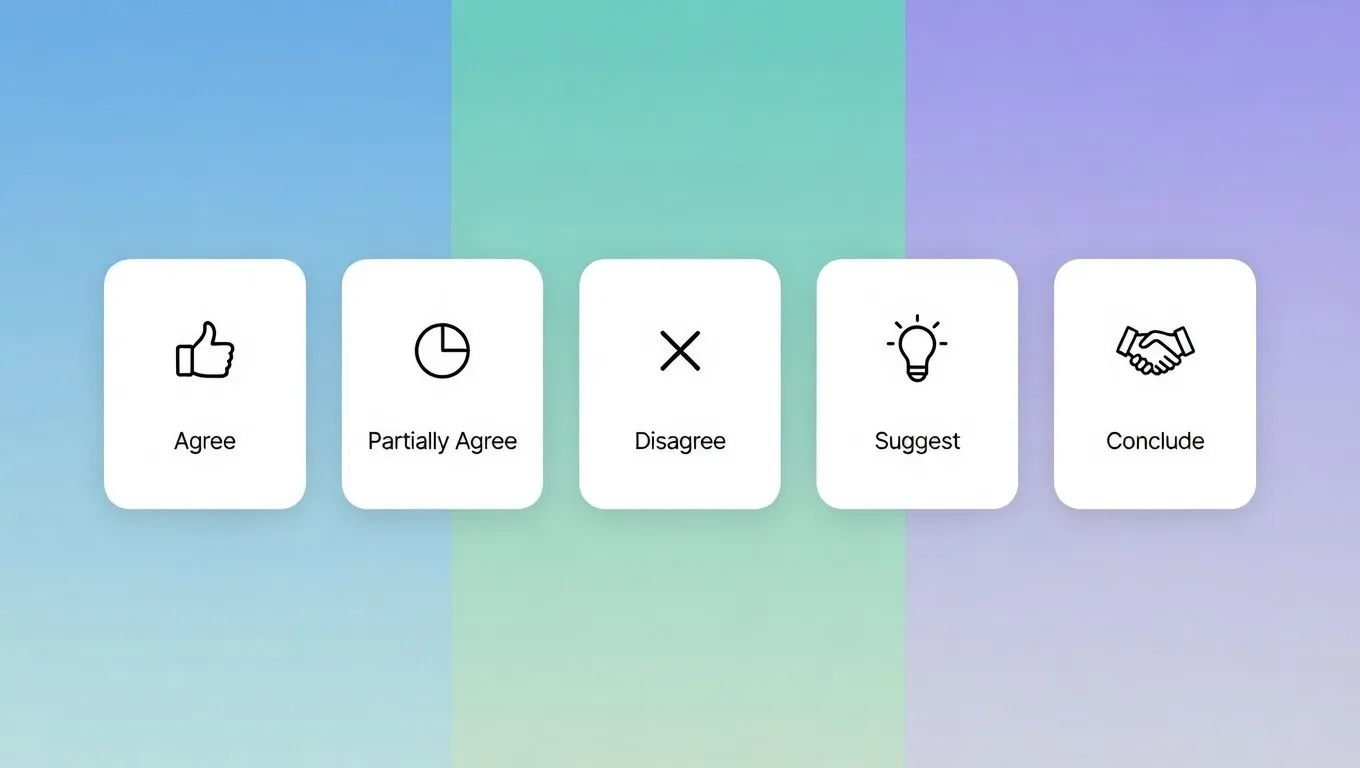
Here are useful B2 Redemittel organised by communication function. Memorise 2–3 from each category:
- •Presenting your position: "Ich vertrete die Auffassung, dass…" / "Meines Erachtens…" / "Aus meiner Sicht…" / "Ich bin der festen Überzeugung, dass…"
- •Supporting your point: "Das lässt sich damit begründen, dass…" / "Ein Beleg dafür ist…" / "Ich habe gelesen, dass…" / "Nehmen wir als Beispiel…"
- •Transitioning: "Kommen wir nun zum nächsten Punkt." / "Ein weiterer Aspekt ist…" / "Darüber hinaus möchte ich anmerken, dass…" / "In diesem Zusammenhang ist auch wichtig, dass…"
- •Summarising: "Zusammenfassend lässt sich sagen, dass…" / "Alles in allem…" / "Abschließend möchte ich betonen, dass…" / "Um es auf den Punkt zu bringen: …"
- •Asking questions: "Darf ich dazu eine Frage stellen?" / "Wie stehen Sie zu…?" / "Was halten Sie von der Idee, dass…?" / "Sehen Sie das auch so?"
B2 Sprechen Scoring Criteria
Each of the three parts is marked on four criteria:
- •Ausdrucksfähigkeit (Expression): appropriate expression and variety of language — up to 7 points per part.
- •Aufgabenbewältigung (Task Fulfilment): participation in the conversation, strategies, fluency — up to 7 points per part.
- •Formale Richtigkeit (Formal Correctness): syntax and morphology — up to 7 points per part.
- •Aussprache und Intonation (Pronunciation and Intonation): up to 4 points per part.
That makes 25 points per part and 75 in total. Expression, task fulfilment and grammatical correctness carry the same weight (7 points each per part); pronunciation and intonation carry 4. Grammar is only one of four criteria — taking an active part in the conversation counts just as much. There is no separate fluency score: fluency is assessed under Aufgabenbewältigung.
Common B2 Sprechen Mistakes
- •Reciting a memorised text in Teil 1. You may prepare the topic at home, but speak freely — and be ready for your partner's questions.
- •Not interacting with your partner. Treating the discussion as two separate monologues instead of a real exchange. React to what your partner says and refer to their points.
- •Agreeing with everything. Saying "Ja, gute Idee" to every suggestion in Teil 3 shows little participation. Bring your own ideas and suggest an alternative now and then.
- •Going silent when thinking. Long pauses cost points for Aufgabenbewältigung, where fluency is assessed. Use filler phrases: "Das ist eine interessante Frage. Lassen Sie mich kurz überlegen…" / "Also, wenn ich darüber nachdenke…"
- •Switching to English or your native language. If you cannot find a word, describe it in German — that is a strategy, and strategies are part of Aufgabenbewältigung.
- •Not concluding Teil 3. Always end the planning task with a clear summary of what you decided. "Also, wir haben beschlossen, dass…"
How to Practise B2 Sprechen Effectively
Practising B2 speaking alone is hard because the exam is a conversation. Talking to yourself in the mirror can help with Teil 1 (your experience report), but it does not prepare you for the back-and-forth of Teil 2 and Teil 3.
LevelKraft gives you telc-style B2 Sprechen tasks. Record your response and receive AI feedback on it, so you see what to improve — for example which Redemittel to add and where your structure breaks down.
Get AI Feedback on Your B2 Speaking
LevelKraft offers B2 speaking practice in telc format. Record your answer and get AI feedback on it, so you know what to improve. LevelKraft is free to start — download it on Google Play.
TELC B2 Sprechen Quiz (5 Questions)
Test whether your B2 speaking strategy is exam-ready. Score and explanations after each answer.
1. What do you talk about in Teil 1 of telc B2 Sprechen?
2. Which phrase expresses partial agreement?
3. How long is the preparation time before the telc B2 oral exam?
4. In Teil 3 (Gemeinsam etwas planen), what should you do?
5. What should you do if you need time to think during the speaking exam?
Verwandte Themen
Practice for your B2 exam with LevelKraft
Full model tests, AI feedback and progress tracking — free to start.
Get the app free