
How to Pass the TELC B2 German Exam in 2026: The Section-by-Section Strategy
The complete strategy to pass TELC B2 on your first attempt. Section-by-section breakdown of Leseverstehen, Hörverstehen, Schreiben, and Sprechen — with scoring, timing, study plan, and the critical differences from B1 that catch people off guard.

TELC B2 is where the exam gets real. If B1 tested whether you can survive in everyday German, B2 tests whether you can think, argue, and communicate in German at a professional level. The jump from B1 to B2 catches more people off guard than any other level transition — not because the grammar is dramatically harder, but because the exam demands an entirely different set of skills.
This guide gives you the exact strategy to pass TELC B2 on your first attempt. Every section, every scoring detail, every trap — and the specific preparation approach that works for each part. If you have your exam booked or you are planning to register, this is the resource you need.
The B2 Pass Rule
You need 60% overall to pass TELC B2. But — and this is critical — you must pass both the written AND oral sections separately. If you score 90% on the written exam but fail speaking, you fail the entire exam. You cannot compensate across sections. This rule catches more people than any single question on the test.
TELC B2 Exam Format: The Complete Breakdown

The written exam takes approximately 140 minutes and covers four areas: Leseverstehen (reading comprehension, 3 parts), Sprachbausteine (language elements, 2 parts), Hörverstehen (listening comprehension, 3 parts), and Schreiben (writing, 1 task). The reading and Sprachbausteine are combined into a 90-minute block with 40 questions. Listening takes about 20 minutes. Writing gives you 30 minutes.
The oral exam (Sprechen) takes about 15 minutes with a partner, plus 20 minutes of preparation time beforehand. It has three parts: a personal experience presentation, a discussion about a controversial topic, and a joint planning task. Speaking carries 25% of your total score.
What Makes B2 Fundamentally Different from B1
The biggest shift is not vocabulary or grammar — it is the type of thinking the exam requires. At B1, you mostly need to find facts in texts and write simple structured letters. At B2, you need to understand arguments, identify opinions in complex audio, write formal argumentative texts, and present and defend positions in speaking. This is a cognitive skill, not just a language skill.
- •Leseverstehen: Texts are longer, more abstract, and use more complex sentence structures. The questions test whether you understand the argument, not just the facts.
- •Hörverstehen: Audio plays only ONCE for all three parts. At B1, parts 2 and 3 play twice. This single change makes B2 listening dramatically harder — you cannot zone out for even 10 seconds.
- •Schreiben: Instead of a simple informal letter, you write a formal Beschwerdebrief (complaint letter) or Anfrageschreiben (request for information) that requires structured argumentation.
- •Sprechen: You are expected to present arguments, respond to counterpoints, and negotiate — not just describe experiences and make simple suggestions.
Leseverstehen + Sprachbausteine: 90 Minutes, 40 Questions, 105 Points
This is the longest block of the exam and where effective time management makes or breaks your score. You have 90 minutes for 3 reading parts plus 2 Sprachbausteine parts. Reserve the last 10 minutes for transferring answers to the answer sheet.
- •Teil 1 — Heading Matching (5 questions, 25 points): You match 10 headings to 5 texts. Five headings are distractors. Read headings first, then skim each text for the main idea. Do not get trapped by texts that share a similar topic — focus on the specific angle of each heading.
- •Teil 2 — Detailed Reading (5 questions, 25 points): One longer text with 5 multiple-choice questions. Read the questions first, then scan the text. TELC almost never uses the exact same wording in the text and the correct answer — look for synonyms and rephrased ideas.
- •Teil 3 — Matching (10 questions, 25 points): 12 short texts (ads, listings, blurbs) matched to 10 situation descriptions. Some texts have no match. Some situations have no match. This is the trickiest part — be precise about every detail in the situation description.
- •Sprachbausteine Teil 1 (10 questions, 15 points): Gap-fill with 3 options per gap. Tests grammar: prepositions, verb forms, conjunctions, articles. Trust your instinct first — if one option immediately sounds right, it usually is.
- •Sprachbausteine Teil 2 (10 questions, 15 points): A text with 10 gaps where you fill in the correct word from a word bank. Tests vocabulary and collocations. Read the full sentence around each gap before choosing.
Time Management Strategy
Recommended time split: Teil 1 (15 min), Teil 2 (20 min), Teil 3 (25 min), Sprachbausteine 1+2 (20 min), Transfer answers (10 min). If you get stuck on any single question for more than 2 minutes, mark your best guess and move on. Coming back with fresh eyes is more effective than staring.
Hörverstehen: The Section That Fails the Most People
At B2, all audio plays only once. This is the single biggest difficulty increase from B1. There is no second chance, no rewind, no going back. If you miss a detail, it is gone. This means your listening preparation needs to specifically train single-listen comprehension — not the repeated-listen comfort zone most learners stay in.
- •Teil 1 — Global Understanding (5 questions): Listen to a news report or informational broadcast and decide if statements are richtig (true) or falsch (false). Focus on the overall message, not individual words.
- •Teil 2 — Detailed Comprehension (10 questions): A radio interview or expert discussion — the longest and hardest listening part. Take notes aggressively. Write down key phrases, not full sentences. You need to catch specific details, opinions, and arguments.
- •Teil 3 — Selective Listening (5 questions): Short announcements or informational clips. Match specific information to questions. This part is faster — stay sharp until the very end.
Daily listening practice is non-negotiable for B2. Listen to Deutschlandfunk, Deutsche Welle news, or interview podcasts every day — not as background, but as focused, active listening. After each piece, try to summarize the main argument in one sentence. This trains exactly the skill the exam tests.
Schreiben: Structured Argumentation, Not Just Communication
The B2 Schreiben gives you 30 minutes to write either a Beschwerdebrief (formal complaint) or an Anfrageschreiben (request for information). The key difference from B1: you need to argue, not just communicate. Your letter must have a clear structure with an opening, problem description, your expectations, and a formal closing.
- •Step 1 — Anlass (Opening): State why you are writing. Reference the specific situation from the prompt. "Ich schreibe Ihnen bezüglich…" / "Ich beziehe mich auf Ihr Angebot vom…"
- •Step 2 — Sachverhalt (Problem/Situation): Describe what happened or what you need. Be factual, use Präteritum for past events. Keep sentences clear — a complex sentence with an error costs more than a simple sentence without one.
- •Step 3 — Forderung/Bitte (Your expectation): State clearly what you want. "Ich erwarte eine Rückerstattung in Höhe von…" / "Ich bitte Sie, das Problem bis zum [Datum] zu beheben." / "Könnten Sie mir bitte weitere Informationen zu… zusenden?"
- •Step 4 — Abschluss (Closing): Formal, polite close. "Ich freue mich auf Ihre baldige Rückmeldung." / "Für Rückfragen stehe ich Ihnen gerne zur Verfügung." Sign off with "Mit freundlichen Grüßen."
B2 Schreiben Scoring
You are scored on three criteria: task completion (did you address all required points?), communicative design (is your text structured, coherent, and appropriately formal?), and linguistic correctness (grammar, vocabulary range). A well-structured letter with a few grammar errors will always outscore a grammatically ambitious but chaotic letter. Structure is king.
Sprechen: 25% of Your Score — Three Parts, 15 Minutes
The B2 speaking exam is a pair examination — you do it with another test taker, not the examiner. You get 20 minutes of preparation time before the exam to make notes. Use every second of this time. The exam has three parts, each worth 25 points.
- •Teil 1 — Präsentation (5 minutes total): Present a personal experience related to a given topic (about 1.5 minutes), then answer your partner's questions. Prepare a clear 3-part structure: introduction (what the topic means to you), main experience (concrete story), conclusion (what you learned). Then listen to your partner's presentation and ask at least one genuine question.
- •Teil 2 — Diskussion (5 minutes): Discuss a controversial topic based on a short text. You must express your opinion with reasons AND respond to your partner's arguments. Use phrases like: "Da stimme ich Ihnen teilweise zu, aber…" / "Das sehe ich anders, weil…" / "Ein wichtiger Punkt ist meiner Meinung nach…" The key is interaction — monologues kill your score.
- •Teil 3 — Gemeinsam planen (5 minutes): Plan an event or activity together. Make concrete suggestions, react to your partner's ideas, and reach a joint decision. "Ich schlage vor, dass wir…" / "Was halten Sie davon, wenn…" / "Einverstanden, dann machen wir das so."
The four grading criteria are: Ausdrucksfähigkeit (range and precision of expression), Aufgabenbewältigung (task fulfillment), Formale Richtigkeit (grammatical accuracy), and Aussprache/Intonation (pronunciation and fluency). At B2, examiners expect you to use complex structures — Konjunktiv II, Passiv, Nebensätze with various conjunctions. Using only simple present tense sentences signals B1, not B2.
The 8-Week TELC B2 Study Plan
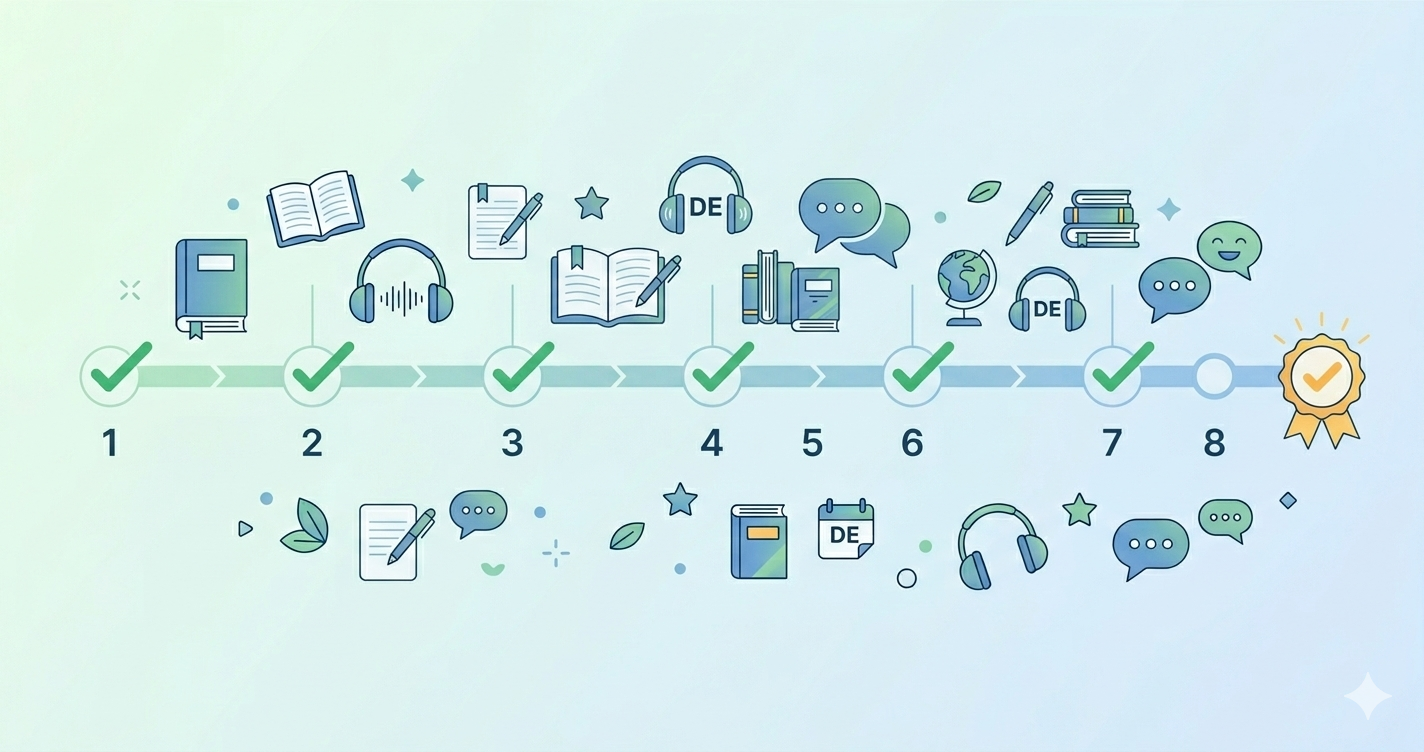
- •Weeks 1–2: Diagnostic + Format Familiarization — Take one full TELC B2 mock test under timed conditions without studying first. Identify your weakest section. Download the free Modelltest from telc.net. Begin daily Hörverstehen practice (15 min/day minimum).
- •Weeks 3–4: Reading + Sprachbausteine Deep Dive — Work through Leseverstehen tasks part by part. For Sprachbausteine, drill preposition-verb combinations, subordinate clause connectors, and Konjunktiv II forms. Complete at least 2 timed reading sections per week.
- •Weeks 5–6: Writing Sprint + Speaking Foundation — Write two Schreiben tasks per week (one Beschwerdebrief, one Anfrageschreiben). Get feedback — ideally same-day AI feedback. For speaking, record yourself responding to B2 presentation prompts. Review your own recordings for fluency gaps and filler-word habits.
- •Weeks 7–8: Full Mock Tests + Final Polish — Take 2 complete timed mock exams in real conditions. Review every wrong answer. Focus Sprechen practice on your weakest sub-skill. Rest 2 days before the exam — arriving exhausted costs more points than extra cramming.
The 8 Most Common Reasons People Fail TELC B2
- •Underestimating the B1-to-B2 jump. B2 is not just 'harder B1' — it requires different skills: argumentation, opinion expression, and active single-listen comprehension.
- •Not practicing under single-listen conditions. If you always replay audio, you are not training the actual skill the exam tests.
- •Writing unstructured Schreiben. A rambling letter that misses the formal structure loses major points even if the grammar is good.
- •Ignoring Sprechen until the last week. Speaking is 25% of your total score. You cannot cram speaking skills — they require weeks of practice.
- •Using only B1-level vocabulary in the speaking exam. At B2, examiners expect upgraded expressions: 'wesentlich' instead of 'wichtig', 'Herausforderung' instead of 'Problem', 'überzeugend' instead of 'gut'.
- •Not interacting with your speaking partner. Monologues kill your interaction score. You must react to what your partner says, agree, disagree, and ask follow-up questions.
- •Poor time management on Leseverstehen + Sprachbausteine. 90 minutes for 40 questions is tight. Getting stuck on one difficult question cascades into lost time across the entire block.
- •Not practicing with actual TELC format tests. The TELC B2 format is specific — practicing with general B2 German exercises does not prepare you for the exact task types you will face.
What Happens If You Fail?
TELC B2 can be taken as a partial examination. If you pass the written exam but fail speaking (or vice versa), you only retake the failed section within one year. This saves both money and stress. A full retake costs €170–€250; a partial retake typically costs €150–€220 depending on the center.
Your TELC B2 certificate, once issued, is valid indefinitely — it never expires. This is a major advantage over IELTS and TOEFL which expire after two years.
How LevelKraft Accelerates Your B2 Preparation
The hardest part of B2 preparation is getting quality feedback on Schreiben and Sprechen. Writing a Beschwerdebrief is useless practice if nobody tells you whether your structure and argumentation score well against TELC criteria. Recording a speaking presentation teaches you nothing if you cannot objectively assess your fluency, grammar range, and task completion.
LevelKraft provides full TELC B2 mock tests across all four sections with AI-powered feedback in under 2 minutes. For writing, you get detailed scoring on task completion, structure, and grammatical range. For speaking, you record your answer and receive analysis of pronunciation, fluency, argument quality, and vocabulary level — the exact criteria TELC examiners use.
Close the Feedback Gap
Most B2 candidates study in a vacuum — they write letters nobody checks and give presentations nobody evaluates. LevelKraft changes that equation. AI-scored writing and speaking practice means you can do 3 feedback cycles in the time it takes to wait for one tutor response. Download free on Google Play and take your first B2 mock test today.
Quick Check: Are You Ready for TELC B2?
5 questions to test whether you understand what B2 actually demands. Score + explanations after each answer.
1. How many times does the audio play in the TELC B2 Hörverstehen?
2. What type of text do you write in the TELC B2 Schreiben section?
3. In the B2 Sprechen, what happens if you only give monologues without interacting with your partner?
4. How much total time do you get for Leseverstehen + Sprachbausteine combined?
5. Can you retake only one section if you fail part of TELC B2?
Verwandte Themen
Mit LevelKraft für deine B2-Prüfung üben
Vollständige Modelltests, KI-Feedback und Fortschrittsverfolgung — kostenlos.
App kostenlos ladenAlles zur TELC B2 Prüfung
Prüfungsaufbau, Tipps, FAQ und Schnelltest